

)
Key takeaways
- 1
Fresh and wet cat food both provide high moisture, but they differ significantly in ingredient transparency, cooking methods, and processing.
- 2
Not all wet food is equal. Always check whether it's complete or complementary and look for named meat ingredients rather than vague animal derivatives.
- 3
Fresh cat food is gently cooked at lower temperatures, helping preserve ingredient quality while offering complete, balanced nutrition with clearly identifiable ingredients.
- 4
Choose the food that best fits your cat's needs and your lifestyle. Wet food offers convenience and shelf life, while fresh food prioritises transparency, minimal processing, and real ingredients.
- 5
When changing diets, transition gradually over 7–10 days to help your cat adapt comfortably and minimise digestive upset.
Did You Know?According to a 2025 consumer survey reported by Global Pet Industry, 88% of pet owners said accurate and transparent pet food labelling is important when choosing a product, and nearly 60% said transparency is "very important." This growing demand for clearer ingredient information is one reason more owners are taking a closer look at what's actually inside their cat's food bowl. |
Walk into any pet shop or supermarket, and you'll find shelves lined with pouches, trays, tins and boxes promising happier, healthier cats.
Meanwhile, fresh cat food has started appearing in freezers, subscription services and social media feeds, often positioned as the next evolution in cat nutrition.
Which naturally leads to a question many owners are now asking:
What is the difference between fresh and wet cat food?
At first glance, they seem remarkably similar. Both are soft. Both contain moisture. Both look far more appetising than dry biscuits.
Yet behind the packaging lies a very different story about ingredients, preparation methods and nutritional philosophy.
This guide explores the facts behind Fresh cat food vs wet cat food, helping you understand what goes into each option and which may be the best fit for your cat.
Why Wet Food Became The UK's Favourite Choice For Cats
For decades, wet food has been the default choice for many cat owners. And for good reason. Compared with dry food, wet food contains significantly more moisture, often making it more appealing to cats and easier for owners to serve.
Many cats naturally prefer softer textures and stronger aromas, both of which wet food provides. This has led many owners to ask:
Is wet cat food good for cats every day?
For most healthy cats, complete wet food can absolutely form part or all of a balanced daily diet. Its moisture content may help support hydration, particularly for cats that don't naturally drink much water.
Wet food is also convenient. Open a pouch. Serve dinner. Watch your cat appear from absolutely nowhere.
The challenge isn't whether wet food can be good. The challenge is that "wet food" describes an enormous category. Some recipes contain clearly named ingredients and high meat content. Others rely more heavily on derivatives, fillers or less transparent ingredient descriptions.
Which means understanding the label becomes far more important than simply choosing a pouch over a biscuit.
What Is In Wet Cat Food Pouches?
This is where things become more complicated. Many owners ask What is in wet cat food pouches expect a simple answer: "Meat."
But ingredient labels often tell a more detailed story. Common wet cat food ingredients may include:
Meat and animal derivatives
Fish and fish derivatives
Vegetable derivatives
Minerals
Oils and fats
Gelling agents
Vitamins and nutritional additives
None of these ingredients is automatically bad. The important question is understanding what they actually mean. For example, "chicken" is very different from "meat and animal derivatives." One tells you exactly what's in the recipe. The other leaves far more open to interpretation.
That's why ingredient transparency has become such a major talking point in the debate around Fresh cat food vs wet cat food.
The more clearly a food explains what's inside, the easier it becomes for owners to make informed decisions.
What Can Ingredient Labels Tell You About Your Cat's Food?
Ingredient labels are often written to satisfy regulations rather than curious cat owners. Which means they can sometimes feel more confusing than helpful. A typical label might contain terms like:
Meat derivatives
Animal derivatives
Vegetable derivatives
Ash
Analytical constituents
All perfectly legal. All commonly used. Yet most owners have little idea what they actually mean. Named ingredients generally provide greater transparency because they identify specific proteins such as chicken, salmon or turkey.
Broader ingredient descriptions may contain a wider range of animal-derived materials without specifying their source. Again, this isn't necessarily negative. But it does make comparing foods more difficult.
When evaluating wet cat food ingredients, transparency often matters just as much as the ingredient list itself. Because if you don't know what's in the bowl, it's difficult to assess its quality.
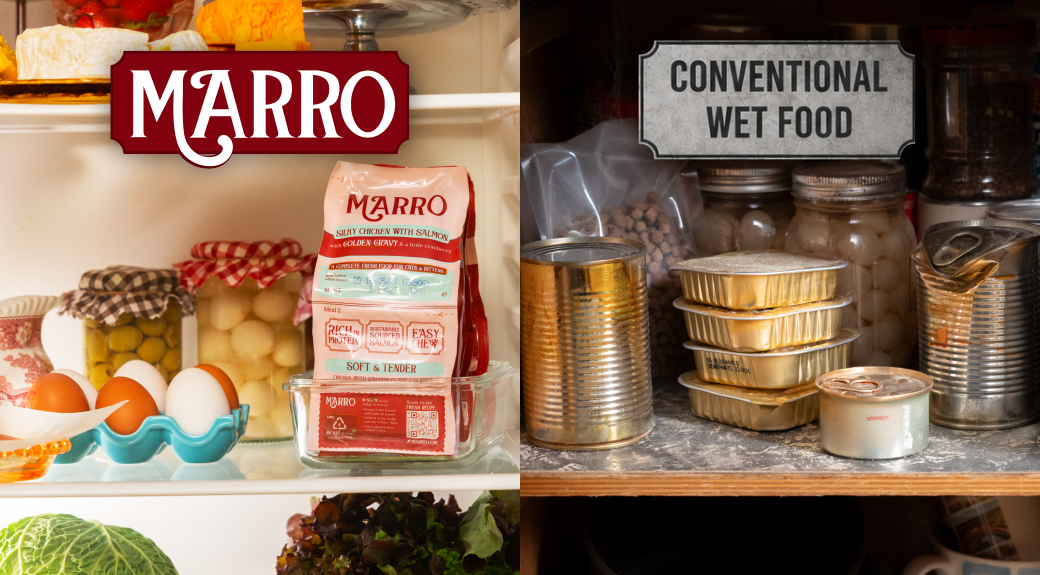
Demystifying the Label: The Reality of Wet Cat Food Ingredients
Reading a standard supermarket cat food label requires a minor degree in pet food regulatory law. The back of almost every commercial pouch features an ingredients list that feels deliberately designed to obscure rather than reveal.
The Legal Loopholes
The 4% Meat Rule: Under UK labeling regulations, if a package states it is "With Savoury Chicken," the manufacturer is only legally required to include a minimum of 4% chicken from that specific animal source within the recipe.
Shifting Protein Bases: The remaining 96% is grouped under the broad phrase "meat and animal derivatives". This legal term allows factories to swap protein sources batch-by-batch based on fluctuating market wholesale prices without changing the packaging.
Chronic Irritation: Shifting the base protein from beef to pork or mutton from week to week is a frequent trigger for chronic digestive issues and sudden food sensitivities in discerning cats.
What To Look For On The Label
When comparing foods, ask:
✓ Is the protein source clearly named?
✓ Is the meat percentage disclosed?
✓ Are animal ingredients listed first?
✓ Is the food complete and balanced?
✓ Does the ingredient list feel transparent?
The goal isn't to find the highest number on the packet. The goal is understanding what that number actually represents.
Aha! A food containing 70% named chicken tells you far more than a food containing unspecified animal derivatives, even if both are technically meat-based diets. |
Complementary Vs Complete Wet Cat Food: Why The Difference Matters
One of the most misunderstood labels in cat nutrition is: complementary vs complete wet cat food.
The difference is surprisingly important. A complete food contains all the nutrients a cat needs when fed as directed. A complementary food does not. It may be intended as a topper, treat, or occasional addition to the diet.
Unfortunately, many owners don't notice the distinction until after they've bought the product. Think of it this way:
A complete food is designed to be dinner.
A complementary food is designed to accompany dinner.
When comparing Fresh cat food vs wet cat food, this distinction matters because fresh recipes are often designed as complete and balanced meals from the outset.
Always check the label before feeding any food as your cat's primary diet.
The Cooking Chemistry: Extreme Thermal Sterilization vs. Steaming at 90 Degrees
The structural differences between these two options extend far beyond the initial raw ingredients list; it is deeply embedded in how the food is cooked.
Standard mass-market wet cat food is subjected to an aggressive process called pressure retorting, blasting sealed pouches at temperatures often exceeding 121°C. Marro consciously rejects this approach, choosing to steam ingredients at a controlled temperature of 90 degrees.
The Scorch-Earth Effects of Retort Canning (121°C+)
Denatured Proteins: Intense heat alters the complex three-dimensional structure of vital animal proteins, making it far more difficult for feline digestive enzymes to break them down.
Oxidized Lipids: Essential fatty acids, including vital omega-3 and omega-6 chains, are heavily damaged by high thermal pressure, turning them rancid and stripping their anti-inflammatory properties.
Synthetic Re-Supplementation: Natural micronutrients disintegrate under retort temperatures. Manufacturers must spray an artificial slurry of synthetic powders back onto the material just to meet baseline requirements.
The Science of Low-Temperature Steaming (90°C)
Preserved Bioavailability: Keeping temperatures firmly at 90 degrees preserves the native cellular structures of the fresh meat.
Intact Micronutrients: Fragile lipids and amino acids remain intact, allowing the food to retain its true taste without needing artificial flavor enhancers.
Meticulous Additives: Complete nutrition requires meticulous care. We add tailored vitamins, minerals, and essential taurine to our recipes post-cook to ensure safety and strict alignment with the latest FEDIAF European Nutritional Standards, building upon a robust foundation of uncompromised real food.
Why This Matters
Cooking doesn't just affect storage. It also affects:
Texture
Aroma
Moisture retention
Ingredient structure
Palatability
Cats experience food through smell first and taste second. Which means how food is prepared can have a surprisingly large impact on how enthusiastically it's received.
Aha! Most owners compare ingredients. Cats often compare aromas. Cooking influences both. |
Fresh Cat Food Vs Wet Cat Food: Side By Side Comparison
If you've made it this far, you're probably looking for a simple comparison. Not another nutritional lecture. Here's the short version.
Factor | Fresh Cat Food | Wet Cat Food |
Moisture Content | High | High |
Ingredient Transparency | Usually named ingredients | Varies by brand |
Storage | Frozen | Shelf stable |
Cooking Method | Gently cooked, then frozen | High-temperature retort cooking |
Meat Source Visibility | Typically clear | Sometimes broad ingredient descriptions |
Shelf Life | Shorter once thawed | Long unopened shelf life |
Convenience | Requires freezer space | Ready from cupboard |
Processing Level | Minimal compared with shelf-stable foods | More processing required for preservation |
Complete Nutrition Available | Yes | Yes |
Suitable For Daily Feeding | Yes | Yes (if complete food) |
So... best cat food wet or fresh?
The answer depends on what matters most to you. If convenience and long storage life are priorities, wet food may be the better fit. If ingredient transparency, named proteins, and freshness matter most, fresh food may be worth exploring.
Many owners who compare Fresh cat food vs wet cat food discover that both options offer advantages over dry food. The decision often comes down to how much value you place on freshness, ingredient visibility, and preparation methods.
The Behavioral Shift: What Happens When Your Cat Meets Fresh Food?
If fresh food is so biologically superior, why do some cats initially turn their noses up at it when first introduced? The answer lies in an industry practice known as palatability engineering.
Navigating the Sensory Reset:
The "Digest" Coating: Mass-market manufacturers coat dry kibble and fill wet pouches with chemically engineered flavor enhancers known internally as "digests." These sprays act like a hyper-concentrated sensory additive, intentionally designed to trigger an addictive feeding response.
The Natural Clean Slate: Real, gently steamed fresh meat lacks these intense, artificial chemical coatings. To a cat accustomed to industrial flavor engineering, fresh food can initially seem unfamiliar.
The 7-to-10-Day Swap Protocol: By slowly mixing expanding portions of Marro into their old food, you allow their sensory receptors to safely reset from industrial flavor additives. Once their palate adjusts to the clean, subtle aroma of genuine, uncompromised real meat, they rarely ever look back to the cupboard.
Which Option Is Best For Your Cat?
After comparing ingredients, cooking methods and hydration, many owners still arrive at the same question: best cat food wet or fresh?
The truth is that there isn't one universal answer. The best food is the one that provides complete nutrition, suits your cat's individual needs and fits comfortably into your lifestyle.
1. For Kittens
Growing cats need diets that support healthy development and provide appropriate levels of protein, fats, vitamins and minerals.
Whether you choose fresh food or wet food, look for a recipe that is suitable for kittens and clearly labelled as complete and balanced. Organisations such as AAFCO and FEDIAF use the term "complete and balanced" to indicate that a food is designed to meet recognised nutritional requirements for a particular life stage.
2. For Adult Cats
Most healthy adult cats can thrive on either fresh food or high-quality wet food. The biggest differentiators often become:
Ingredient transparency
Protein quality
Moisture content
Personal preference
3. For Senior Cats
Older cats can become more selective about food texture and flavour. Because many senior cats also benefit from maintaining good hydration, foods with higher moisture content can be particularly useful. Research continues to show that dietary moisture plays an important role in overall water intake and urinary health.
4. For Sensitive Stomachs
Cats with digestive sensitivities often benefit from simpler ingredient lists and clearly identified protein sources. This is one reason some owners choose fresh food, where ingredient transparency tends to be easier to evaluate.
5. For Fussy Eaters
Let's be honest. Cats are wonderfully mysterious creatures. The food they ignored yesterday may become their obsession tomorrow.
Many owners find that fresher aromas and recognisable ingredients can encourage enthusiasm at mealtimes, although individual preferences always vary.
Aha!Rather than asking whether fresh food or wet food is universally better, ask: Which option allows me to clearly understand what I'm feeding my cat while meeting their individual needs? That question often leads to a far more useful answer. |
The Hydration Question: Do Cats Need Wet Or Fresh Food?
One area where fresh food and wet food have more in common than differences is hydration. Cats evolved from desert-dwelling ancestors and naturally have a relatively low thirst drive. Because of this, they often obtain a significant portion of their water from food rather than from drinking alone.
This is one reason many veterinarians and nutrition experts view moisture-rich diets favourably.
Research has consistently shown that cats consuming higher-moisture diets generally achieve higher total water intake than cats consuming dry-only diets. Studies have also found increases in urine volume and reductions in urine concentration when wet food forms a larger proportion of the diet.
The good news? Both fresh food and wet food can contribute meaningful moisture to a cat's diet. So when comparing Fresh cat food vs wet cat food, hydration alone is rarely the deciding factor.
Instead, the conversation often shifts toward ingredient quality, processing methods, and nutritional philosophy.
Is Fresh Cat Food Worth The Money?
Let's address the question many owners are quietly thinking: Is fresh cat food worth the money?
The answer depends on what you're measuring. If you're looking only at the cost per meal, fresh food will often be more expensive than many supermarket pouches. However, most owners who choose fresh food aren't paying purely for calories.
They're paying for factors such as:
Named ingredients
Transparent recipes
Gentle cooking
Fresh-frozen storage
Portion personalisation
Convenient home delivery
For some households, those benefits justify the additional cost. For others, a high-quality wet food may represent a better balance between budget and nutrition. There isn't a right or wrong choice. What's important is understanding exactly what you're paying for.
Aha! The question isn't always: "Is fresh food more expensive?" It's often: "What additional value am I getting for the difference in price?" |
Why More Owners Are Switching From Wet Food To Fresh Cat Food
Over the past few years, more owners have become interested in ingredient transparency and minimally processed nutrition. As a result, switching from wet food to fresh cat food has become increasingly common. That doesn't mean wet food is suddenly inadequate, far from it.
Rather, many owners simply want:
More clarity about ingredients
Named meat and fish
Fewer vague ingredient descriptions
Freshly prepared recipes
A feeding experience that feels closer to real food
This is where brands like Marro have started to resonate with modern cat owners.
Marro's recipes use named ingredients, are gently cooked at 90°C and then frozen to lock in freshness. The result is a complete and balanced meal designed to deliver the convenience owners need while maintaining the transparency many are now seeking.
Most importantly, transitions should always happen gradually. When switching from wet food to fresh cat food, a slow introduction over several days can help cats adjust comfortably to new flavours and textures.
Conclusion: Fresh Or Wet? The Best Choice Is An Informed One
The debate around Fresh cat food vs wet cat food isn't really about declaring a winner. Both formats can provide moisture-rich nutrition. Both can play a valuable role in a healthy feeding routine.
The real difference lies in understanding:
What's in the food
How it's prepared
Whether it's complete and balanced
How transparent the ingredients are
What works best for your individual cat
If convenience and shelf stability are your priorities, wet food remains a popular and practical option.
If ingredient transparency, named proteins and fresh preparation appeal to you, fresh food may be worth exploring. Ultimately, the best feeding decision is the one made with knowledge rather than marketing.
And when you understand the difference between fresh and wet food, you're already one step closer to making the right choice for your cat.
CTA: Book Your Fresh Cat Food Meal
Frequently Asked Questions
1. Is Wet Cat Food Good For Cats Every Day?
Yes, provided it is labelled as a complete food and fed according to feeding guidelines. Complete foods are designed to provide all the nutrients a cat needs for a particular life stage, while complementary foods are intended to be fed alongside other foods. Always check the packaging before making any food your cat's primary diet.
2. What Is The Difference Between Fresh And Wet Cat Food?
The main differences typically involve ingredient transparency, cooking methods, and storage. Wet food is usually heat-processed and packaged to remain shelf-stable, while fresh food is generally gently cooked and frozen. Both can provide valuable moisture, but they often differ in how ingredients are sourced, prepared and presented.
3. What Does Complementary Vs Complete Wet Cat Food Mean?
A complete food contains all the nutrients required for daily feeding. A complementary food does not and should be fed alongside other foods to provide balanced nutrition. This distinction is recognised by pet food regulatory and industry guidelines in both Europe and North America.
4. Is Fresh Cat Food Better Than Pouches?
There isn't a universal answer. Fresh food often appeals to owners seeking ingredient transparency and minimally processed recipes, while pouches offer convenience and long shelf life. The best option depends on your cat's needs, your preferences, and the quality of the individual food being compared.
5. How Long Does It Take To Switch From Wet Food To Fresh Cat Food?
Most cats adapt best when changes are introduced gradually over 7–10 days. Serving increasing amounts of fresh food alongside the current diet can help minimise digestive upset and allow cats to become familiar with new flavours and textures.
6. How Much Meat Is In Wet Cat Food?
Meat content varies considerably between recipes. Some foods clearly state high percentages of named meat or fish, while others use broader ingredient descriptions. Reading labels carefully is often the best way to understand exactly what you're feeding your cat.
Related articles
)
)
)
)
)