

)
Key takeaways
- 1
Fresh cat food retains more natural nutrients and moisture thanks to gentle cooking at around 90°C, while kibble is extruded at temperatures above 150°C, which reduces nutrient retention.
- 2
Dry kibble typically contains significantly more carbohydrates because starch is required during manufacturing, whereas fresh food is naturally high in animal protein and lower in carbohydrates.
- 3
Premium kibble may offer better ingredients than standard kibble, but it is still highly processed and generally lower in moisture than fresh cat food.
- 4
The belief that kibble cleans cats' teeth is largely a myth. Regular tooth brushing and routine veterinary dental care remain the most effective ways to maintain oral health.
- 5
Switching from kibble to fresh food should be gradual over 10–14 days, allowing your cat to adjust to the new taste, texture, and aroma while supporting better long-term hydration and nutrition.
Did You Know?Cats can become surprisingly loyal to crunch. That’s because Many dry foods are coated with fats and flavour enhancers after cooking to improve palatability. Over time, some cats become attached not only to the taste, but also the texture, smell and routine of eating kibble. Which means when owners start switching their cats from dry food to fresh, they're often changing more than a diet, and it can take up to a week to adjust. But owners have every reason to be excited about the process, as they're helping their cat discover that real food can be exciting, too. |
What Happens When Cat Food Starts Behaving More Like Food?
Fresh food isn't trying to reinvent cat nutrition. It's trying to remember it. A 2025 review published in the Journal of Feline Medicine and Surgery highlighted that cats are obligate carnivores with nutritional requirements that remain heavily dependent on animal-derived nutrients, particularly protein and essential amino acids such as taurine.
When people compare fresh cat food vs kibble, they're often comparing two very different approaches to feeding cats. Fresh food is typically:
Made with real meat and fish
Rich in natural moisture
Gently cooked at 90°C
Stored chilled rather than shelf-stable
Served in a form that still resembles food
At Marro, our recipes are built around ingredients you'd recognise, not ingredients that require a chemistry degree to pronounce.
The goal isn't novelty. It's simplicity. Because cats have been thriving on meat-rich, moisture-rich diets for a very long time.
Why Does Kibble Look The Way It Does?
Because convenience shaped the recipe long before your cat did, to understand kibble vs fresh cat food, it helps to understand what kibble actually is.
Most dry cat food is produced through a process called extrusion.
All ingredients are mixed into a dough, cooked under heat and pressure, shaped into biscuits, dried and then coated with fats or flavourings.
The result?
A shelf-stable product that's easy to store and transport. That's one reason kibble became so popular. Convenience is a powerful invention.
But convenience and biology aren't always the same thing.
What Is In Dry Cat Food?
The answer depends on the brand. When people ask what is in dry cat food, they often discover the ingredients vary dramatically. Some premium kibble brands prioritise named meat ingredients.
Others rely more heavily on cereals, starches, vegetable proteins and processed derivatives. That's why reading labels matters.
The first few ingredients usually tell you a lot about what you're actually feeding. Cats don't need fancy marketing. They need good nutrition.
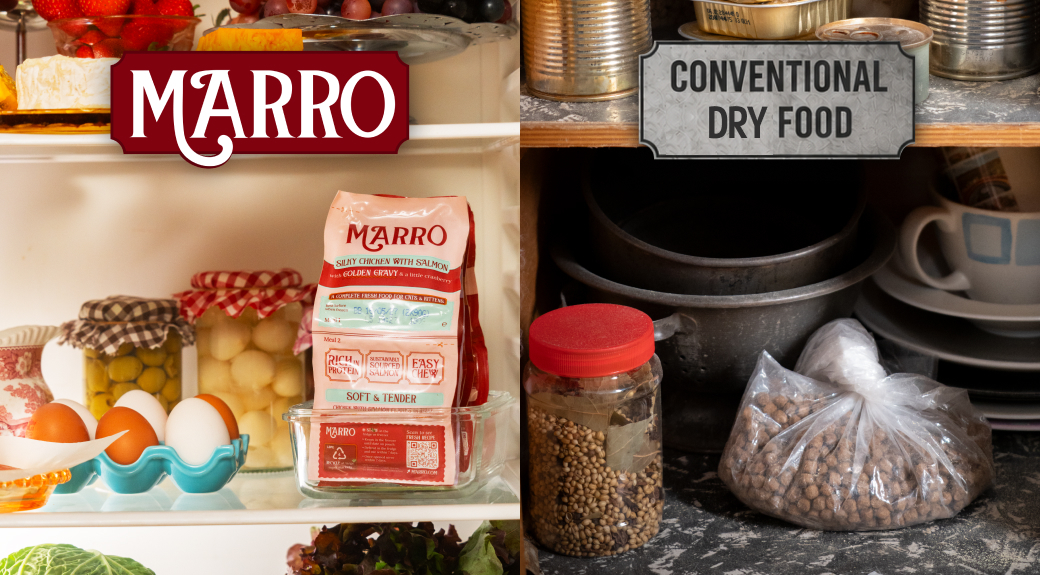
Cats Didn't Evolve Around Kibble. Kibble Evolved Around Humans.
One was designed for convenience. The other was designed by nature.
When comparing Fresh vs. dry cat food for cats, it's worth remembering one important fact:
"Cats are obligate carnivores. Their ancestors weren't hunting biscuits. They were hunting moisture-rich prey."
The extrusion process, in plain terms: ingredients are mixed into a paste, water and steam are added, and the mixture is forced through an extruder at temperatures typically exceeding 150°C, under extreme pressure.
That's what creates the pellet or biscuit shape. The food is then dried to remove moisture down to roughly 8–10%.
Key fact: kibble is cooked at over 150°C. Marro is gently cooked at 90°C. That 60-degree-plus gap determines a surprising amount of what actually survives into your cat's bowl.
What that heat does to nutrition when we compare fresh vs. dry cat food for cats:
Heat-sensitive vitamins, including B vitamins and vitamin C, are significantly degraded at 150°C and above.
Taurine, an essential amino acid that cats cannot produce themselves, is damaged by high heat and has to be added back synthetically after cooking.
Proteins are denatured, which reduces their digestibility and bioavailability.
Complex carbohydrates are converted into simple sugars by the heat and pressure of the process itself.
The result: nutrients often have to be added back after processing from a supplement premix, not from the original food
Marro's approach is the structural opposite: simmered gently in its own golden gravy. Hot enough to eliminate bacterial risk, cool enough to preserve taurine, B vitamins, and protein structure far more naturally. The food is then frozen immediately, locking in nutritional quality at its peak.
A simple way to picture fresh vs. dry cat food for cats: imagine a three-bar comparison: kibble extrusion at 150°C+, wet food retort cooking at around 121°C, and fresh food at 90°C. Each step down the temperature scale is a step toward nutrition that survives the cooking process intact, rather than needing to be reconstructed afterwards. |
How Much Carbohydrate Is In Dry Cat Food?
This is where the conversation gets interesting. One of the most searched questions is: How much carbohydrate is in dry cat food?
The exact amount varies by recipe. However, because kibble requires starch during manufacturing, dry foods often contain more carbohydrates than fresh food.
Cats have no nutritional requirement for carbohydrates. They can digest them. But they don't biologically require them. Their metabolism, enzyme systems, and digestive tract are built almost exclusively around animal protein.
In the wild, a cat's natural prey contains less than 2% carbohydrate. Standard dry cat food typically contains 25–50% carbohydrate, mostly from the grains and starches needed structurally to hold kibble together during extrusion.
Recent cat diabetes nutrition guidelines published in 2025 continue to recommend low-carbohydrate, high-protein diets as the preferred nutritional approach for supporting glucose regulation in cats, reflecting the species' natural adaptation to protein-rich diets.
A few specific points worth understanding:
Cats lack significant amounts of glucokinase, a key enzyme for efficient glucose metabolism, unlike dogs and humans, who handle dietary carbohydrate comfortably.
The extrusion process itself converts complex carbohydrates into simpler sugars, creating a glucose response that a cat's metabolism isn't well equipped to manage.
Excess carbohydrate that isn't used for energy tends to be stored as fat, which is a contributing factor in the UK's high rates of feline obesity.
Which is why many owners exploring fresh cat food vs kibble start paying closer attention to carbohydrate content.
Why is Kibble Bad For Cats?
This is probably the biggest question in the entire debate you can ask otherwise. Is dry cat food bad for cats?
The honest answer? Not necessarily. Many cats live long lives eating dry food.
The better question is: Does dry food represent the most natural way for cats to eat?
That's where opinions begin to differ. Fresh food generally offers:
More moisture
Less processing
Higher meat inclusion
Lower carbohydrate levels
That doesn't mean kibble is automatically harmful. It simply means the two foods are fundamentally different.
Why Your Cat Seems to 'Love' Kibble, And What's Really Going On
This is the part of the comparison between fresh vs. dry cat food for cats almost nobody talks about, and it directly answers the single most common objection to switching: "my cat won't eat anything else."
The flavour engineering reality: kibble isn't appealing to cats because it's nutritionally superior. It's appealing because pet food manufacturers apply palatability enhancers to the outside of every piece after cooking.
These typically include:
Animal digest sprays: rendered, processed animal material sprayed onto the surface
Fat coatings: high-fat sprays that create an immediately rewarding smell and taste
Flavour enhancers: compounds specifically designed to make the food compelling, even when the underlying ingredients are fairly ordinary.
The practical result: a cat that's eaten kibble for years has been conditioned to prefer it not because it's better food, but because it's been engineered to be irresistible. It's the feline equivalent of ultra-processed food built for repeat consumption rather than nutritional value.
Your cat doesn't prefer kibble. They've been engineered to crave it. That's a very different thing.
What this means in practice: a cat refusing fresh food isn't making a considered nutritional judgement. They're reacting to the absence of flavour chemicals they've come to expect. That's not a dead end; it's exactly why a slow, structured transition (covered below) works so reliably, and why patience matters more than almost anything else in this process.
Fresh Cat Food vs Kibble: Full Comparison
Is Premium Kibble Better Than Fresh Food? A fair question.
Factor | Standard Kibble (Supermarket) | Premium Kibble | Marro Fresh Cat Food |
Cooking Method | Extrusion at 150°C+, high pressure | Extrusion at 150°C+ (same process) | Gentle cooking at 90°C |
Moisture Content | 8–10% | 8–10% | ~70%, via golden gravy |
Meat Content | Often 25–40%, bulked with grain/starch | 40–90% animal ingredients | 70%+ human-quality named meat |
Carbohydrates | 25–50% | 10–30% | Near-zero |
Taurine | Destroyed at 150°C+, added back synthetically | Destroyed and added back | Naturally present, topped up with a small supplement for consistency |
Ingredient Quality | Often unnamed by-products | Named proteins, better sourcing | 100% named, human-quality cuts |
Preservatives | Often, yes, BHA, BHT, artificial antioxidants | Usually reduced | None, frozen immediately after cooking |
Dental Claims | Marketing claim, minor surface effect only | Marketing claim, minor surface effect only | Not claimed, proper brushing recommended instead |
Cost (approx/day) | £0.30–£0.60 | £0.80–£1.80 | Comparable to premium kibble, portion-controlled |
Is Premium Kibble Better Than Fresh Food?
Premium kibble is usually better than budget kibble.
It often contains:
Better ingredients
More animal protein
Improved formulation
Greater transparency
But even premium kibble remains a dry, highly processed product. Fresh food and kibble solve different problems. Kibble prioritises convenience.
Fresh food prioritises moisture, ingredient quality and minimal processing. Which matters more depends on your priorities.
Does Kibble Clean Your Cat's Teeth?
This is the most common reason owners give for keeping some dry food in the diet even after switching most meals to something fresher. It deserves a straight answer.
Some research suggests the mechanical crunching action of kibble may remove a degree of surface plaque. That's the basis for the "cleans teeth" claim you'll see on packaging. However:
This surface effect does nothing to prevent periodontitis, the most common and serious dental disease in cats.
Periodontitis develops below the gumline, where crunching kibble has no reach or effect.
The British Veterinary Association does not recommend dry food as a dental hygiene tool.
The only evidence-based way to genuinely protect a cat's teeth is regular brushing and routine veterinary dental checks.
Some specific dental health formulas (Hill's Dental Care, for example) are purpose-designed and evaluated by the Veterinary Oral Health Council, but these are specialist products, distinct from general kibble.
For clarity: fresh food doesn't provide a dental cleaning effect either, and neither does wet food. Whatever your cat eats, regular brushing and annual dental checks with your vet remain the only properly evidenced approach. |
Switching Your Cat from Kibble to Fresh Food
This is the most practically important section here, and it's longer than it would be for a wet-to-fresh transition, because kibble-to-fresh is genuinely the hardest switch to make. Flavour spray conditioning makes kibble-habituated cats more resistant to change than wet-food cats typically are. Be realistic going in, and be patient throughout.
Why this transition is harder than others: cats accustomed to kibble have been conditioned by flavour enhancers to find it highly rewarding. Fresh food smells different, looks different, and has a completely different texture. Most cats won't accept it immediately, and that's entirely normal, not a sign they don't need or want it.
Switching food can be a big change for cats. They may need about 3 days to adjust to new tastes and textures - totally normal. With a bit of patience (and chicken), most cats settle in smoothly.
Day 1: start small with chicken
Serve a spoonful of warmed Succulent Chicken on a clean plate.
Remove their old food and treats so they can focus.
Warming tip: pop the pouch in warm water for 10 minutes, or microwave for 10 seconds.
Let your cat sniff and explore - if they don’t eat, take it away after 20 minutes and serve their usual food instead.
Your first boxes are typically more chicken heavy to make this step easier.
Day 2: increase amounts
If they ate some on day 1, slowly increase the portion size.
Stick with Succulent Chicken for now - it’s easy on the stomach.
If they didn’t try it yet, repeat day 1’s approach.
Day 3: build familiarity
Keep increasing the Marro portions while reducing old food.
Once they’re comfortable with chicken, start offering the other recipes in your box for variety.
Tips and reassurance
Every cat has their own rhythm - some take longer, and that’s okay.
Stick with it: Fresh food brings big benefits like shinier coats, better digestion (yes, less smelly poos), more energy, and healthier weight.
If your cat resists, don’t give up. Small changes lead to long-term health and happiness. Read stories from cat humans who kept going and saw the changes for themselves here.
If your cat refuses food entirely for more than 48 hours at any point, contact your vet. Cats shouldn't go without food for extended periods, regardless of what's causing the refusal.
A 2025 UK Pet Food Manufacturers' Association report found that pet owners increasingly rank ingredient quality and nutritional value among the most important factors when choosing food for their pets. Cats may not read labels. But more owners are. |
The Bottom Line
Kibble isn't poison, and fresh food isn't magic. What's actually true is more specific and, honestly, more useful than either of those framings: dry food is cooked at a temperature that degrades several nutrients, which then need to be added back synthetically; it sits at a moisture level a long way below what a cat's biology is built around.
None of that means a cat fed kibble for years has been harmed. It means the trade-offs are real and worth understanding on their own terms, rather than through marketing claims pulling in either direction.
Marro is one example of food built around the lower-temperature, higher-moisture approach described throughout this piece, gently cooked at 90°C, with real, named meat and a hydrating gravy in every bowl.
If you'd like to see exactly how that stacks up against kibble factor by factor, including cost, the full comparison lives on our :
Fresh vs Wet Cat Food: Is the pouch in your cupboard as good as you think? We compare ingredients, cooking and nutrition. → /why-fresh-cat-food/fresh-vs-wet
Fresh vs Raw Cat Food: Raw feeding has real appeal, and real risks. Here's the honest comparison. → /why-fresh-cat-food/fresh-vs-raw
Why Fresh Cat Food?The hub page covering everything you need to know about fresh food for cats. → /why-fresh-cat-food/
CTA: Build Your Fresh Cat Food Meal Now
Frequently Asked Questions
1. Is dry cat food bad for cats?
Dry cat food isn't immediately harmful; millions of cats live on kibble for years without obvious issues. But surviving and genuinely thriving aren't the same thing. Kibble is chronically dehydrating (around 10% moisture), high in carbohydrates that cats aren't biologically built to process efficiently, and cooked at temperatures that degrade nutrients, which then have to be added back synthetically. For long-term kidney health, weight, digestion, and coat condition, fresh-cooked food represents a meaningful upgrade.
2. Can cats live on dry food only?
Yes, cats can survive on dry food alone, but it isn't optimal. The two biggest risks are chronic low-grade dehydration, which puts ongoing stress on the kidneys and urinary tract, and elevated carbohydrate intake from the starches needed structurally to form kibble. Adding water to dry food or supplementing with wet food helps somewhat, but fresh food addresses both issues at the source rather than compensating for them afterwards.
3. What is the difference between fresh and dry cat food?
Kibble is made by extrusion ingredients cooked at over 150°C under high pressure, which degrades nutrients and reduces moisture to around 10%. The resulting product typically needs synthetic nutrient top-ups and artificial palatability enhancers to be appealing and nutritionally complete. Fresh cat food is gently cooked at 90°C, retains far more natural nutrient content, including taurine, contains around 70% moisture, and doesn't rely on synthetic flavour additives to be eaten readily.
4. Is premium kibble better than fresh food?
Premium kibble is genuinely better than budget kibble: higher meat content, better ingredient sourcing, less filler. But it's still extruded at 150°C and above, still retains only around 10% moisture, and still needs key nutrients added back after the heat process degrades them. Even the highest-rated dry foods on the market can't replicate the nutritional integrity of food cooked at 90°C with roughly 70% moisture content.
5. Why won't my cat eat fresh food after being on kibble?
Kibble is engineered with palatability enhancers, fat and flavour sprays applied after cooking, specifically to make it highly appealing and habit-forming. A kibble-conditioned cat isn't rejecting fresh food because it's worse; they're reacting to the absence of flavour chemicals they've come to expect. The fix is a slow, structured transition over 10–14 days, warming the new food to release aroma, and removing access to kibble between meals during the switch.
6. Does kibble clean cats' teeth?
This is a marketing claim that independent research doesn't fully support. The mechanical crunching of kibble may remove some surface plaque. Still, it doesn't prevent periodontitis, the most common and serious dental disease in cats, which develops below the gumline where crunching has no effect. The only properly evidenced way to protect a cat's teeth is regular brushing and routine veterinary dental checks, regardless of diet type.
7. How long does it take to switch a cat from kibble to fresh food?
Most cats transition within 7–14 days, though kibble-conditioned cats can take three to four weeks. Patience is the key variable: go slowly, mix the new food into the existing kibble in gradually increasing proportions, warm it to release aroma, and remove kibble access between meals throughout. Once the transition is complete, removing kibble entirely (rather than keeping it as a fallback) helps avoid resetting the process.
Related articles
)
)
)
)
)